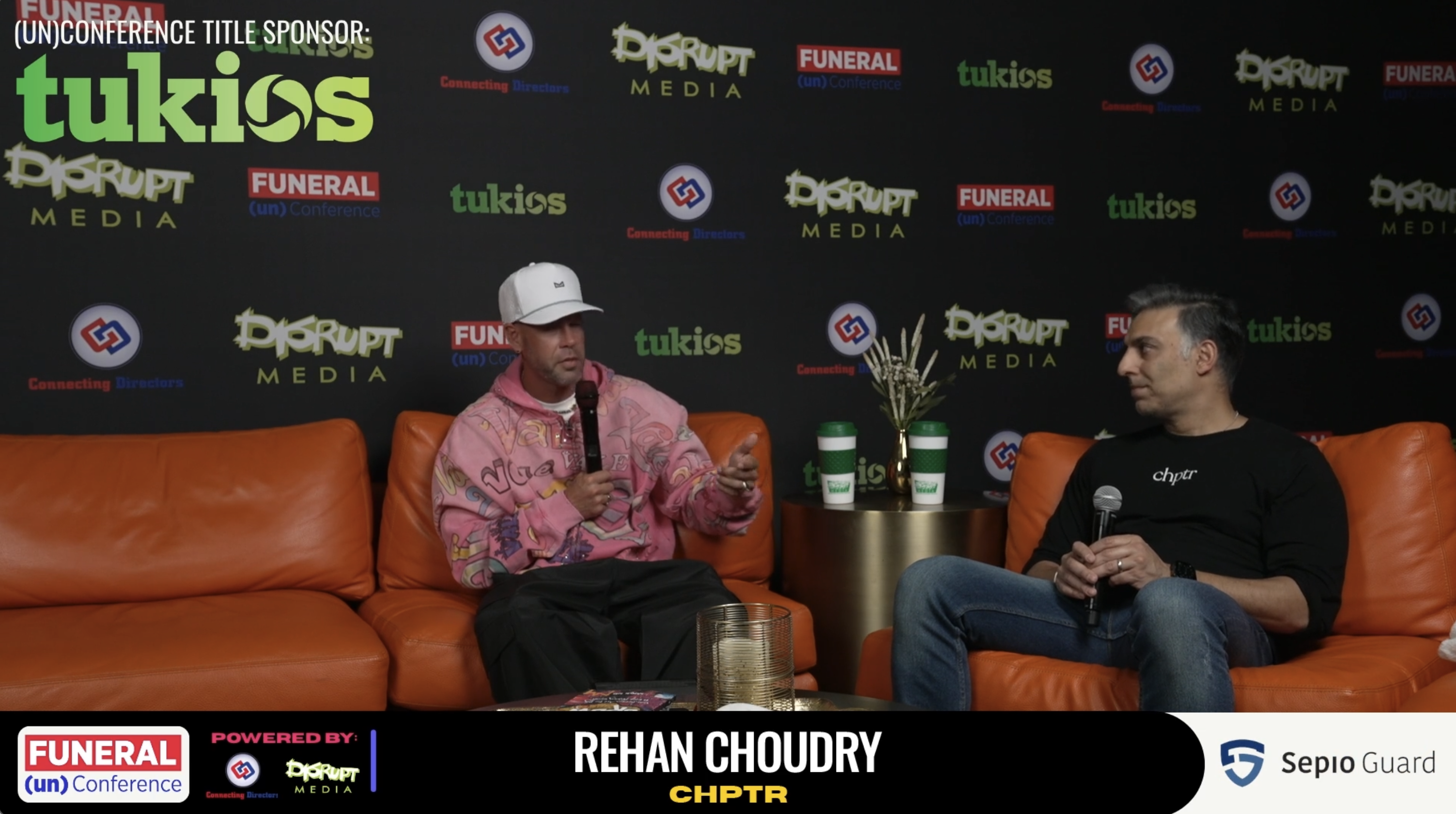
Local TV is dying. Everyone knows it. So when Ryan Thogmartin of Disrupt Media sat down with our Founder and CEO, Rehan Choudhry, for a 1:1 at the 2026 Funeral (Un)Conference, that's exactly where he started: why build a company around a medium everyone's already written off?
The (Un)Conference is hosted by Ryan, with just the panelists together in a room in Scottsdale, Arizona. Rehan was there for two conversations, the 1:1 with Ryan first, then a tech panel with Curtis Funk (Tukios), Craig Greenside (Tribute Technology), and Josh McQueen (Passare). Both are below.
Why we bet on local TV
Rehan's answer came down to audience. The prime customer base funeral homes want to reach skews 55 and older, and that generation is still getting its weather, traffic, and local news from broadcast TV and radio.
If that's where the audience already is, that's where the obituary needs to be too.
Rehan also told the story behind this year's billboard activation in Times Square. We were offered a fifteen minute slot on one of the biggest screens in the city, the kind of placement brands spend a fortune fighting over, and the obvious move would have been to run an ad. Instead, we put funeral directors on the board. Their faces. Their names. A thank you, in the middle of Times Square, to a profession that rarely gets one.
Funeral directors rented limos to come see it in person. They brought their families. Their staff. Rehan's read on why it mattered wasn't complicated: these are neighbors and colleagues who care deeply about their communities long before they ever put the suit on, and for fifteen minutes, the whole city got to see that too.
One story from the conversation has stayed with us longer than the rest. A while back, we aired a 90 second segment featuring Tim Szczesny of DeMunn Funeral Home. No script, no production value to speak of, just Tim on a recorded video call, talking about why he became a funeral director in the first place. About being five years old, riding around town with his dad in the hearse, and what that did to him.
After it aired, people started stopping him. At the grocery store. At his kids' little league games. Not because the segment looked expensive. Because it was true, and people can tell the difference.
That was the 1:1. Rehan also joined the tech panel with Curtis Funk, Craig Greenside, and Josh McQueen, where the conversation moved from local TV to something bigger: AI.
AI is a thought partner, not a replacement
It's easy to assume AI is coming for every job eventually, including this one. That's the fear the tech panel tackled head-on when Rehan joined Curtis, Craig, and Josh.
Rehan doesn't buy it. In his six years in the profession, the two questions he's heard most from directors are how much something costs and whether it creates more work. The tools worth adopting solve for both, and the ones worth trusting free up time rather than replace the person doing the job. Families need someone in front of them at three in the morning after a car accident. Not a chatbot.
The number that stuck with the whole panel: roughly 85%. That's how much of a funeral home's website traffic comes from the obituary page alone, and Curtis Funk and Craig Greenside both landed on it independently in their own research. Rehan's read was that an obituary isn't really digital content. It's local news. Who passed, what the services are, how to send flowers, that information is timely in a way most marketing isn't, and it has to travel through both digital and analog channels to do its job.
Watch both conversations
Local TV isn't dying to the people who still turn it on every night. And an obituary that reaches them isn't outdated either. Both conversations are embedded above.
Chptr partners with funeral homes across every TV market nationwide to deliver Broadcast Memorial Announcements on local affiliate stations. If you're exploring how to reach the full community when a family loses someone, we'd be glad to talk.